Author: Ailen

  • GoodToGoInsurance Coverage Options and Discounts

    By
    GoodToGoInsurance.org Editorial Team
    — Insurance content contributors

    The GoodToGoInsurance.org Editorial Team produces informational content about auto insurance topics, with a focus on plain-language explanations of coverage options, pricing factors, policy requirements, and common driver questions.

    Articles are designed to help readers better understand insurance basics, compare coverage choices, and make more informed decisions when shopping for car insurance.

    Content reviewed internally for clarity, consistency, and general insurance accuracy.

    Note: This content is for general informational purposes only and does not constitute insurance, legal, or financial advice. GoodToGoInsurance.org is an independent informational website and is not affiliated with any insurer.

    GoodToGoInsurance is best for drivers who need the cheapest coverage possible with the most discounts. Goodtogo auto insurance offers fast, flexible insurance without the complications that come with traditional providers. 

    Whether you’re dealing with a lapse in coverage, credit challenges, or simply want a more straightforward way to get insured, GoodToGoInsurance focuses on accessibility, speed, and affordability. Understanding the coverage options and discounts available through GoodToGoInsurance can help you decide whether it’s the right solution for your needs and how to keep your monthly cost as low as possible.

    This guide breaks down GoodToGoInsurance coverage options in clear terms, explains how discounts work, and shows how drivers can maximize value while staying legally protected on the road.

    Overview of GoodToGoInsurance Coverage

    GoodToGoInsurance primarily focuses on essential auto insurance coverage that meets state minimum requirements while offering optional protections for drivers who want more security. The emphasis is on practical coverage rather than complicated bundles, making it easier for drivers to get insured quickly.

    Unlike traditional insurers that require extensive underwriting and long approval processes, GoodToGoInsurance streamlines enrollment. Many drivers are approved the same day, making it a popular option for those who need immediate proof of insurance.
    GoodtoGoInsurance

    Liability Coverage Through GoodToGoInsurance

    Liability insurance is the foundation of most auto insurance policies, and GoodToGoInsurance offers liability coverage that satisfies state-mandated minimums. This coverage helps pay for bodily injury and property damage if you are found at fault in an accident.

    GoodToGoInsurance liability coverage is well-suited for drivers who:

    • Need legal compliance to register or drive a vehicle
    • Want affordable monthly payments
    • Are not looking for high-cost, full-coverage plans

    While liability-only coverage does not protect your own vehicle, it is often the most cost-effective way to stay insured, especially for older cars or drivers on a tight budget.

    Collision Coverage Options

    For drivers who want protection for their own vehicle, GoodToGoInsurance may offer collision coverage as an optional add-on, depending on availability in your state. Collision coverage helps pay for repairs or replacement if your vehicle is damaged in an accident, regardless of fault.

    This type of coverage is particularly useful if:

    • Your vehicle still has significant value
    • You want peace of mind beyond minimum coverage
    • You are financing or leasing your car

    Adding collision coverage increases your premium, but it can prevent large out-of-pocket expenses after an accident.

    Comprehensive Coverage Availability

    Comprehensive coverage protects against non-collision events such as theft, vandalism, fire, falling objects, and weather-related damage. GoodToGoInsurance’s comprehensive options are typically chosen by drivers who live in high-risk areas or want broader protection.

    This coverage can be especially valuable if you:

    • Park your car on the street
    • Live in an area prone to theft or extreme weather
    • Want coverage beyond accidents

    While not required by law, comprehensive coverage adds another layer of financial protection that many drivers find worthwhile.

    Uninsured and Underinsured Motorist Coverage

    GoodToGoInsurance may also provide uninsured or underinsured motorist coverage in states where it is required or commonly offered. This coverage helps protect you if you’re involved in an accident with a driver who has little or no insurance.

    Given the high number of uninsured drivers nationwide, this option can be a smart addition for drivers who want extra protection without significantly increasing their premiums.

    Medical Payments and Personal Injury Protection

    Depending on your location, GoodToGoInsurance may offer medical payments coverage or personal injury protection. These options help cover medical expenses for you and your passengers after an accident, regardless of fault.

    This type of coverage can help with:

    • Emergency room visits
    • Follow-up medical care
    • Lost wages in some states

    For drivers without strong health insurance, this coverage can provide critical financial support after an accident.
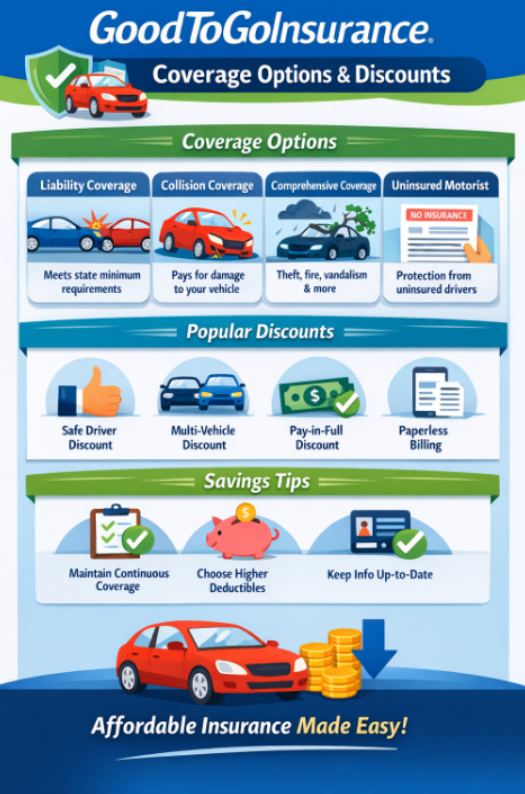
    Goodtogoinsurance Coverage Options and Discounts

    GoodToGoInsurance Discounts Explained

    One of the biggest advantages of GoodToGoInsurance is its focus on affordability. Discounts play a major role in keeping premiums manageable, especially for drivers who may struggle to qualify for savings elsewhere.

    While discounts vary by state and underwriting partner, common GoodToGoInsurance discounts may include:

    🚗
    Safe driving discounts for drivers with clean records
    🔒
    Continuous coverage discounts for maintaining uninterrupted insurance
    🚘
    Multi-vehicle discounts for insuring more than one car
    📄
    Electronic document and paperless billing discounts
    💳
    Pay-in-full or upfront payment discounts

    These savings can add up quickly, especially when combined. Even small discounts can significantly reduce monthly costs over time.

    Discounts for High-Risk and Non-Standard Drivers

    GoodToGoInsurance is often appealing to non-standard drivers, including those with past violations, accidents, or lapses in coverage. While traditional insurers may deny coverage or charge extremely high rates, GoodToGoInsurance works with providers willing to insure higher-risk drivers.

    Although high-risk drivers may not qualify for every discount, maintaining coverage and avoiding new violations can lead to better rates over time. Some drivers see noticeable improvements in pricing after six to twelve months of continuous coverage.

    How to Maximize Savings With GoodToGoInsurance

    Drivers can take several steps to lower their GoodToGoInsurance premium.

    ✔️
    Choose Only the Coverage You Need
    One of the best ways to control costs is to avoid paying for coverage you may not need. For older vehicles, liability-only coverage is often enough.
    📝
    Keep Your Information Updated
    Accurate personal and vehicle details help prevent rating errors. Paying premiums on time and avoiding cancellations may also improve your eligibility for future discounts.
    💰
    Consider a Higher Deductible
    Raising deductibles for optional coverages like collision and comprehensive can lower monthly payments. Though it’s important to ensure you can afford the deductible if you need to file a claim.


    Comparing Coverage Value, Not Just Price

    While GoodToGoInsurance is known for affordability, it’s still important to evaluate coverage value rather than focusing only on the lowest price. Understanding what is and isn’t covered can prevent surprises after an accident.

    GoodToGoInsurance works best for drivers who want straightforward coverage without unnecessary extras. For many, the combination of essential protection, flexible payments, and accessible discounts makes it a practical choice.

    Final Thoughts on GoodToGoInsurance Coverage and Discounts

    GoodToGoInsurance coverage options are built around simplicity, speed, and affordability. From basic liability insurance to optional protections like collision and comprehensive coverage, drivers can customize a policy that fits their needs and budget.

    Discount opportunities further enhance the value of GoodToGoInsurance, especially for drivers who maintain continuous coverage and responsible driving habits. While it may not offer every premium feature found with large national insurers, GoodToGoInsurance fills an important role for drivers who need reliable coverage without unnecessary barriers.

    For drivers looking for a fast, accessible insurance solution, GoodToGoInsurance remains a strong option worth considering.

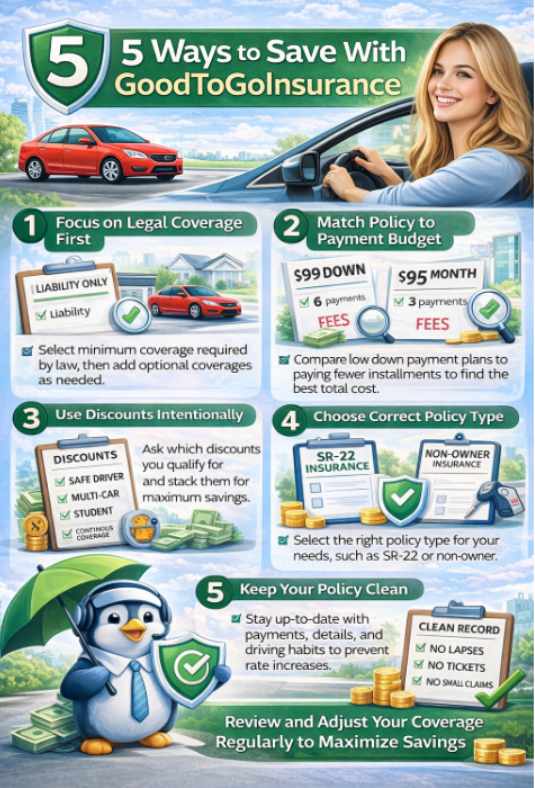
  • Five Ways To Save With GoodToGoInsurance

    By
    GoodToGoInsurance.org Editorial Team
    — Insurance content contributors

    The GoodToGoInsurance.org Editorial Team produces informational content about auto insurance topics, with a focus on plain-language explanations of coverage options, pricing factors, policy requirements, and common driver questions.

    Articles are designed to help readers better understand insurance basics, compare coverage choices, and make more informed decisions when shopping for car insurance.

    Content reviewed internally for clarity, consistency, and general insurance accuracy.

    Note: This content is for general informational purposes only and does not constitute insurance, legal, or financial advice. GoodToGoInsurance.org is an independent informational website and is not affiliated with any insurer.

    Saving money on car insurance with GoodToGoInsurance isn’t about finding a single magic trick. Real savings come from understanding how insurers price risk, choosing coverage that fits your situation, and structuring your policy in a way that avoids unnecessary costs.

    Many drivers overpay simply because they select coverage once and never revisit it, even as their vehicle, driving habits, and financial priorities change.

    This article breaks down five practical and realistic ways to lower what you pay, using GoodToGoInsurance as an example of how a budget-focused carrier can fit into an overall savings strategy when used correctly.

    Start With the Coverage You Actually Need

    One of the most effective ways to save money with GoodToGoInsurance is to clearly separate what you must have from what you choose to have. Every state requires a minimum level of liability coverage, but anything beyond that is optional unless a lender is involved.

    Drivers with older, paid-off vehicles often save the most by focusing on liability-only coverage that keeps them legal and protected against claims from others. Collision and comprehensive coverage protect your own vehicle, but they also add a high cost. If your car’s value is low, paying for those coverages may not make financial sense.

    This is one reason GoodToGoInsurance is often used by drivers who need straightforward coverage without unnecessary extras. The key is being honest about your vehicle’s value and your ability to replace it if something happens. If replacing the car would not create a financial hardship, liability-focused coverage can dramatically reduce premiums.

    That said, liability limits still matter. Choosing higher liability limits can protect your income, savings, and future earnings, and often adds less cost than people expect. Smart saving is about cutting the right things, not cutting protection blindly.

    Coverage Type Best For Cost Impact
    Liability-Only Older, paid-off, lower-value cars Lowest cost
    Full Coverage Newer, financed, or higher-value vehicles Higher cost
    Higher Liability Limits Drivers protecting income and assets Often modest added cost

    Match Your Policy Structure to How You Actually Pay Bills

    Insurance savings are not just about the premium itself. The way you pay for your policy can quietly increase or decrease the total amount you spend over the term. Many drivers focus only on the monthly payment and overlook fees, installment charges, and penalties tied to the payment structure.

    Some policies offer low initial payments but spread the premium across more installments, increasing the total cost. Others reduce the overall price if you pay in fewer payments or in full. The best option depends on your cash flow, not just the sticker price.

    Save with GoodtogoInsurance

    A practical approach is to compare two versions of the same policy. One option uses a lower upfront payment with monthly installments. The other uses fewer payments or a higher upfront amount. When you compare the total cost over the full term, the difference is often larger than expected.

    When drivers use GoodToGoInsurance, this comparison is especially important because the platform is often chosen for affordability and flexibility. Choosing the right payment structure can prevent unnecessary fees and reduce the risk of missed payments, which can lead to coverage lapses and higher future rates.

    How Policy Costs Quietly Rise

    Low upfront focus → More installments → More fees → Missed payment risk → Coverage lapse risk → Higher future premiums

    Use Discounts Intentionally Instead of Assuming They Are Automatic

    Discounts are one of the most misunderstood parts of auto insurance. Many drivers assume that if they qualify, the discount will be applied automatically. In reality, discounts often require verification, enrollment, or documentation.

    Common discounts may include safe driving history, continuous insurance coverage, multi-vehicle policies, student status, and payment-related discounts. Some discounts remain in place as long as you qualify, while others expire and must be renewed.

    The real savings come from stacking multiple discounts together. A single discount may not move the needle much, but three or four combined can significantly lower your premium.

    When working with GoodToGoInsurance, drivers should confirm which discounts are available in their state and which ones are already included in the quote. Asking direct questions about eligibility and documentation helps ensure nothing is missed.

    It is also important to update your information regularly. If your mileage drops, your commute changes, or your household situation improves, those changes can open the door to additional savings.

    Discount Stacking Can Make a Bigger Difference

    Combined savings are often stronger than any one discount alone.

    Important: Discounts may require enrollment, verification, or documentation. Always ask which savings are already included in your quote and which ones require action.

    Choose the Right Policy Type for Your Driving Situation

    One of the most expensive mistakes drivers make is buying the wrong type of policy. Not every driver needs a standard owner policy, and choosing incorrectly can result in paying for coverage that doesn’t actually apply.

    If you don’t own a vehicle but still need insurance for legal or license-related reasons, a non-owner policy is often far cheaper than a standard auto policy. It provides liability coverage when you drive vehicles you don’t own and helps maintain a continuous insurance history.


    Similarly, drivers who need proof of insurance filings should make sure the policy they purchase includes the required documentation from the start. Delays or mistakes can lead to reinstatement fees, fines, or extended periods without coverage.

    GoodToGoInsurance is frequently used in these situations because it can support specialized policy needs without forcing drivers into unnecessary coverage. The savings come from matching the policy to your real driving situation rather than defaulting to a one-size-fits-all option.

    Standard Owner Policy

    • For drivers who own a vehicle
    • Can include liability and physical damage coverage
    • Usually costs more

    Non-Owner Policy

    • For drivers who do not own a car
    • Provides liability coverage only
    • Often costs less

    Avoid Hidden Costs By Keeping Your Policy Clean And Accurate

    The final way drivers lose money is through avoidable risk signals. Insurance pricing is not based only on coverage choices. It also reflects how stable and predictable you appear as a customer.

    Late payments, policy lapses, frequent small claims, and inaccurate information can all increase rates over time. Even something as simple as overstating annual mileage can lead to higher premiums.

    Reviewing your policy details regularly helps prevent these problems. Make sure your address, mileage, vehicle use, and listed drivers are accurate. If something changes, update it promptly rather than waiting for renewal.

    Drivers who use GoodToGoInsurance effectively tend to treat insurance as an active financial tool rather than a set-it-and-forget-it expense. That mindset helps prevent small mistakes from turning into long-term cost increases.

    Late Payments

    Payment problems can raise rates and create unnecessary risk.

    Coverage Lapses

    Even a short lapse can affect future pricing and eligibility.

    Frequent Small Claims

    Repeated claims can make you appear riskier to insure.

    Inaccurate Information

    Wrong mileage, driver details, or usage can quietly increase cost.

    The biggest savings usually come from matching your coverage, payment plan, and policy type to your real situation.

    The Final Word On Saving Money With GoodToGoInsurance

    Saving money on car insurance isn’t about cutting corners. It’s about aligning your coverage, payment structure, and policy type with your real-world needs. The biggest savings usually come from choosing appropriate coverage levels, stacking discounts intentionally, avoiding lapses, and selecting the correct policy for your situation.

    When used thoughtfully, GoodToGoInsurance can be part of a broader savings strategy for drivers who want affordable, straightforward coverage without unnecessary extras. The key is staying proactive, reviewing your policy regularly, and making adjustments as your life changes.

    If you treat car insurance as something you manage instead of something that just happens to you, long-term savings become much easier to achieve. Compare affordable auto insurance quotes online in minutes and save hundreds on the quality coverage you deserve. 

    Editorial note: Coverage options, discounts, payment structures, and eligibility vary by insurer, state, driving history, vehicle type, and policy form. Always review full policy details before purchasing coverage.

  • Get Cheaper Coverage With GoodToGoInsurance

    More drivers are turning to GoodToGoInsurance to save money with direct-to-consumer car insurance. The reality is, auto insurance can feel like a bill that keeps chasing you. Maybe your rates shot up after a ticket, or you had a lapse in coverage, or you’re just tired of huge down payments. That’s where GoodToGoInsurance can be a lifesaver for budget-conscious drivers who still need to stay legal on the road. GoodToGoInsurance is known for helping drivers get cheap, fast, and simple auto coverage, especially when other insurers say no or quote sky-high prices. By offering direct rates, drivers can save 30% and even 40% on a new auto insurance policy.   If you’re looking for the lowest possible rate that still meets your state’s legal requirements, this guide walks you through how GoodToGoInsurance works and how to squeeze every bit of savings out of it. You’ll learn who it’s best for, what it covers, how to lower your premium, and how it compares to other low-cost insurers, all with one mission: helping you get cheaper coverage with GoodToGoInsurance.


    What GoodToGoInsurance Is and How It Helps

    GoodToGoInsurance isn’t a typical insurance company. It functions as an online marketplace that connects you with insurance carriers willing to insure high-risk or budget-focused drivers. Instead of waiting for agents, GoodToGoInsurance quickly matches you with insurers offering low-cost options that fit your situation. The platform is ideal for drivers who want the cheapest state-minimum coverage, fast online approval, SR-22 filings, low or easy down payments, options after a lapse in insurance, and policies without long phone calls and paperwork. For people who have been denied elsewhere or simply need a cheaper way to stay insured, GoodToGoInsurance often becomes the best solution.

    Why More Drivers Are Choosing Cheaper Coverage With GoodToGoInsurance

    People search for GoodToGoInsurance for one main reason: affordability. But the value goes beyond price.

    💵

    Low Down Payments

    Many partner carriers offer policies that start with minimal upfront cost, perfect for drivers who can’t afford big down payments.

    Fast Online Quotes

    You fill in basic info, get matched instantly, and can buy a policy in minutes.

    🚗

    High-Risk Friendly

    Drivers with violations, accidents, DUIs, or lapses often get better options here compared to traditional carriers.

    📄

    SR-22 Support

    If your state requires an SR-22, GoodToGoInsurance can connect you with carriers that file it the same day.

    🪪

    Instant ID Cards

    Perfect if you need proof of insurance right away.


    Coverage Options Available Through GoodToGoInsurance

    Coverage varies by state, but here are the most common options available.

    Liability Coverage

    This is the cheapest and most essential option. It pays for injuries and property damage to others if you’re at fault. It’s required in nearly every state.

    Optional Coverages

    Depending on the carrier and your budget, you may also be able to add collision, comprehensive, PIP, medical payments, uninsured/underinsured motorist, towing or roadside assistance, and rental reimbursement. Most budget-conscious drivers choose liability-only to keep premiums low.

    Drivers Who Benefit the Most From GoodToGoInsurance

    GoodToGoInsurance is designed for drivers who prioritize affordability over luxury-level coverage.

    You’re an ideal match if you:

      • Need the cheapest legal policy
      • Have tickets or accidents
      • Are restarting coverage after a lapse
      • Need SR-22 filing
      • Drive an older or inexpensive car
      • Want a simple policy without extras


    How to Lower Your Rates And Save More

    Here are the strategies that help you secure cheaper coverage with GoodToGoInsurance and reduce your cost the most.

    Stick With State-Minimum Liability

    Liability-only is the cheapest option. If your car isn’t worth much, this often makes sense.

    Raise Deductibles

    Higher deductibles lower monthly premiums if you choose full coverage.

    Report Accurate Mileage

    Driving fewer miles can qualify you for lower rates.

    Choose Cars With Lower Insurance Costs

    Older cars and models with cheaper repair costs typically get lower premiums.

    Pay in Full If Possible

    Paying six months upfront can reduce the total cost.

    Avoid Filing Small Claims

    Multiple small claims can raise your premiums. Save insurance for bigger losses.

    Apply Discounts

    You may qualify for discounts if you insure multiple cars, use autopay, pay in full, have anti-theft devices, are a homeowner, go paperless, or are a good student.

    Average Auto Insurance Rates  

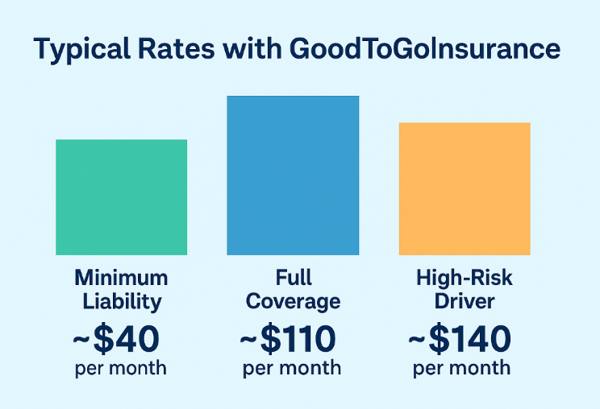
    Prices vary by state, age, driving history, and more. But generally, minimum liability is the cheapest, full coverage costs more, high-risk drivers find friendlier pricing here than with major carriers, and SR-22 riders are often cheaper compared to competitors. The platform aims to help drivers get the lowest possible rate available for their situation.

    How GoodToGoInsurance Compares to Other Budget Insurers

    Drivers seeking cheaper coverage with GoodToGoInsurance often compare it to GEICO, Progressive, Dairyland, or The General. Compared with major carriers, GoodToGoInsurance typically wins on minimum-coverage prices, especially for drivers with imperfect records. Compared with non-standard insurers like The General or Dairyland, GoodToGoInsurance often offers lower down payments and more flexible approvals. 

    Before You Compare Quotes

    • Have your driving details ready
    • Know whether you prefer liability or full coverage
    • Pick your deductible ahead of time
    • Apply every discount
    • Update mileage regularly
    • Re-shop every six months

    The Final Word On GoodToGoInsurance

    If you’re tired of paying too much for auto insurance or you’ve been turned away by traditional carriers, cheaper coverage with GoodToGoInsurance gives you a practical, affordable way to stay insured. It removes the confusion, the paperwork, and the massive upfront costs, replacing them with fast quotes, instant ID cards, and policies that actually fit your budget. What makes GoodToGoInsurance stand out is its simplicity. You get multiple quotes in minutes, same-day coverage, and options even if you have a complicated driving history or need an SR-22. It’s built for real-life drivers who need to stay legal without wiping out their paycheck. If you value low monthly payments, low down payments, and fast online enrollment, GoodToGoInsurance is one of the smartest ways to save. It focuses on one goal: getting you insured, keeping you insured, and helping you keep more money in your pocket.  

    Compare online quotes in about five minutes and save hundreds with direct rates

    For most drivers searching for relief from high insurance costs, that kind of affordability is exactly what they’ve been waiting for.

     
  • GoodToGoInsurance Coverage

    Many drivers want cheaper auto insurance without giving up the protection that actually matters. If you’re looking for coverage that’s fast, affordable, and easy to understand, GoodToGoInsurance can help.

    Whether you need the cheapest liability policy, full coverage for a newer car, or a quick SR-22 filing, GoodToGoInsurance partners with multiple carriers to offer flexible options. This guide breaks down the coverage choices you may see through their partner network, so you know what’s available and how to pick the right plan.

    How GoodToGoInsurance Coverage Works

    GoodToGoInsurance acts as a marketplace that matches drivers with insurance carriers offering budget-friendly and high-risk-friendly policies. This makes it easier to get insured quickly, especially if you need immediate proof of insurance or you’ve had issues like past accidents or lapses in coverage.

    Because coverage comes from multiple partner companies, the exact options and pricing can vary. Still, the major protection categories stay consistent. The overall goal is fast approval with affordable coverage—even if your driving record isn’t perfect.


    GoodToGoInsurance coverage overview

    State-Minimum Liability Coverage

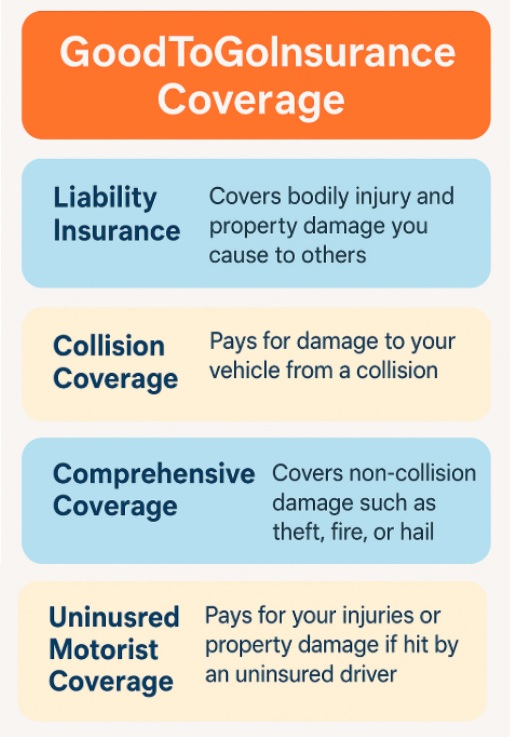
    The most common and affordable option through GoodToGoInsurance is state-minimum liability insurance. It meets the legal requirement to drive and helps pay for damage or injuries you cause to others.

    Liability coverage typically includes two parts:

    1. Bodily Injury Liability – Helps pay for injuries you cause to someone else, including medical bills, lost wages, and legal costs.
    2. Property Damage Liability – Helps pay for damage you cause to another vehicle or property (for example, a fence, mailbox, or building).

    Liability-only is usually the lowest-cost option. It’s often a smart fit for older cars or drivers who mainly want the lowest monthly payment while staying legal.

    Full Coverage Insurance Options

    Drivers with newer or financed vehicles often need full coverage. While “full coverage” isn’t a single policy type, it usually means liability plus:

    • Collision Coverage – Helps pay to repair or replace your car after a crash, regardless of who caused it.
    • Comprehensive Coverage – Helps cover non-collision damage such as theft, vandalism, hail, fire, floods, falling objects, and animal strikes.

    Full coverage is commonly required by lenders and is strongly recommended if you couldn’t afford to replace your vehicle out of pocket.

    Uninsured and Underinsured Motorist Coverage

    Not every driver on the road has enough insurance. Uninsured/underinsured motorist (UM/UIM) coverage helps protect you if the at-fault driver has no coverage (or not enough) to pay for the damage.

    Depending on your state and policy, UM/UIM may help with:

    • Medical bills
    • Lost wages
    • Pain and suffering (where allowed)
    • Property damage in some states

    UM/UIM can be especially valuable for hit-and-run crashes or situations where the other driver can’t pay.

    Medical Payments and Personal Injury Protection

    Depending on your state, you may also have access to MedPay or PIP:

    • Medical Payments (MedPay) – Helps cover medical expenses for you and your passengers after an accident, no matter who was at fault.
    • Personal Injury Protection (PIP) – Helps cover medical costs, lost wages, and rehab expenses. PIP is required in some no-fault states.

    These coverages can prevent you from getting stuck with expensive medical bills after an accident.

    SR-22 Coverage for High-Risk Drivers

    GoodToGoInsurance is commonly used by drivers who need an SR-22 filing. An SR-22 is not insurance—it’s a certificate proving you carry the required liability coverage.

    You may need an SR-22 if you have:

    • A DUI or DWI
    • A suspended license
    • A major accident
    • Driving without insurance
    • Too many violations

    Many partner carriers can file SR-22 forms electronically—often the same day—so you can work toward getting reinstated faster.

    Roadside Assistance Options

    Many GoodToGoInsurance partner carriers offer affordable roadside assistance, which may include:

    • Towing
    • Tire changes
    • Battery jumps
    • Lockout service
    • Fuel delivery

    This add-on is especially useful if you drive long distances, commute daily, or own an older vehicle.

    Rental Reimbursement Coverage

    If your car is in the shop after a covered claim, rental reimbursement may help pay for a temporary replacement vehicle. Many policies provide a daily limit for a set number of days (often around 15–30 days). This can be a must-have if you rely on your car for work or family obligations.

    Glass and Windshield Protection

    Some policies include options for glass repair or replacement. Depending on your state and carrier, this may include:

    • Windshield repair with no deductible (in certain cases)
    • Glass replacement at a reduced rate
    • Standard comprehensive deductible for glass claims

    Glass coverage varies widely, but windshield damage is one of the most common auto claims, which is why many drivers find this add-on worth considering.

    How Claims Work With GoodToGoInsurance

    Claims are handled by the partner carrier you’re matched with. While the exact process depends on the company, many carriers offer:

    • 24/7 claim reporting
    • Fast adjuster assignment
    • Repair shop recommendations
    • Total loss evaluations
    • Digital payment options when available

    Overall, claims are designed to be straightforward, though some high-risk carriers may rely more on phone communication than mobile apps.


    Infographic explaining GoodToGoInsurance coverage types

    Available Discounts to Lower Your Coverage Costs

    Many partner carriers offer discounts such as:

    • Multi-vehicle
    • Good student
    • Safe driver
    • Homeowner
    • Pay-in-full
    • Autopay
    • Anti-theft device
    • Prior insurance

    Stacking multiple auto insurance discounts can make a noticeable difference in your monthly rate.

    Who GoodToGoInsurance Coverage Is Best For

    GoodToGoInsurance can be a strong fit for:

    • Drivers shopping for cheaper coverage
    • High-risk drivers
    • Drivers with a lapse in insurance
    • First-time drivers
    • People who need SR-22 support
    • Owners of older vehicles
    • Drivers who need immediate proof of insurance

    If you want premium concierge service or advanced app-based features, a major insurer may be a better fit. But if your priority is affordability and access, GoodToGoInsurance is often a practical option.

    How to Choose the Right Coverage

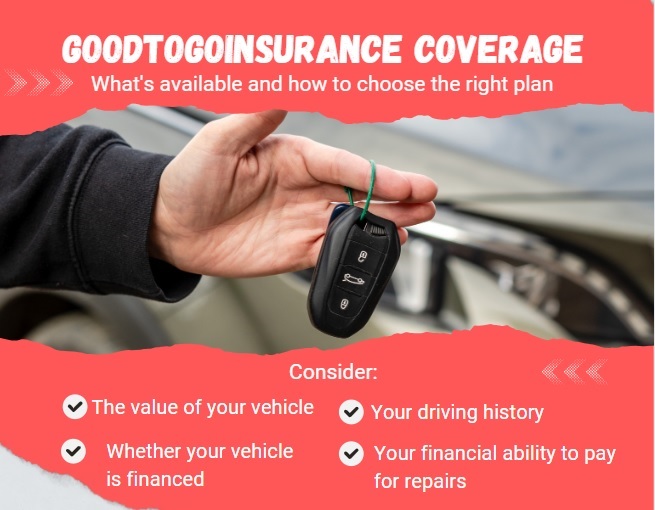
    When comparing coverage options, focus on:

    • Your vehicle’s value
    • Your driving history
    • Your state’s minimum requirements
    • Whether your vehicle is financed or leased
    • Your ability to pay for repairs out of pocket
    • Your overall risk tolerance

    Liability-Only

    Best for older vehicles. Liability-only meets state minimum requirements and helps protect you financially if you injure someone or damage their property.

    Full Coverage

    Best for newer or financed cars. Full coverage usually combines liability with comprehensive and collision to help protect your own vehicle from major repair bills.

    SR-22

    Required if your state mandates it. An SR-22 is a certificate proving you carry the required insurance, often after serious violations or a lapse in coverage.

    Ways to Save Even More on GoodToGoInsurance Coverage

    You may be able to lower your premium by:

    • Raising your deductibles (if you can afford the risk)
    • Removing add-ons you don’t need
    • Keeping continuous coverage
    • Improving your driving record over time
    • Paying the policy in full (when available)
    • Insuring a less expensive vehicle
    • Claiming every discount you qualify for

    GoodToGoInsurance policies are already positioned for affordability, but smart coverage choices and discounts can help reduce costs even further.

    The Final Word On GoodToGoInsurance Coverage

    GoodToGoInsurance offers a wide range of coverage options built around affordability, simplicity, and fast approval. Whether you need basic liability, full coverage, medical protection, SR-22 support, or optional add-ons, their partner carriers provide flexible choices for many different budgets and driver profiles.

    Choosing the right coverage helps you stay legal, protected, and financially secure—without paying for extras you don’t need. GoodToGoInsurance makes that easier for drivers who want a cost-effective solution without a complicated buying process.

  • Cheap Car Insurance Georgia for New Drivers

    Even thinking about cheap car insurance Georgia for new drivers can seem crazy when you’re holding a fresh license. In Georgia, it’s common to joke when handing the keys to your teenager that the insurance premium was higher than the price of their first car. This is because, statistically, young and inexperienced motorists are more likely to get into accidents. Insurers also weigh factors like your credit history and annual mileage, so a brand‑new driver often starts behind the curve. For someone just starting out, all those variables stack the deck against affordable coverage—but as you’ll see, a few insider moves can level the playing field.

    Understanding Georgia’s Car‑Insurance Requirements

    Before hunting for bargains, every driver needs to know the rules of the road. Georgia law requires a minimum liability policy that covers $25,000 for bodily injury per person, $50,000 per accident, and $25,000 for property damage. That basic “25/50/25” plan pays for the other driver’s injuries and repairs if you’re at fault. It does not pay to fix your car.

    On the other hand, full coverage adds collision and comprehensive protection, which pays to repair or replace your vehicle, whether you hit a tree, a deer, or get caught in a hailstorm. If you lease or finance a car, the lender will insist on full coverage. Even if you own your car outright, you might choose full coverage to avoid a nasty surprise after a fender‑bender, but you’ll pay more for the extra protection.

    “So,” you might ask, “should I buy more than the minimum?” Insurance professionals usually recommend higher liability limits (think $100k/$300k/$100k). Medical bills and lawsuits can blow past the minimum quickly. In other words, the minimum keeps you legal, but higher limits keep you safe.

    Cheap car insurance in Georgia for new drivers

    What Makes Coverage Expensive for New Drivers?

    New drivers in GA often experience sticker shock when they see their first auto insurance quotes. Insurance companies view inexperienced motorists as high-risk clients, resulting in substantially higher premiums compared to seasoned drivers.

    Below, we break down the biggest influences on your premium and what you can do about them.

    Lack of Experience

    For starters, insurers know that less experience behind the wheel means more accidents; male teen drivers in Georgia average roughly $3,506 a year for car insurance, while their female counterparts pay about $3,363. Rates usually drop around age twenty‑five, but that doesn’t help you today.

    Credit Scores Matter

    Unfortunately, you can’t find “no credit check car insurance” just anywhere in GA. Insurance companies can consider a “credit‑based insurance score,” and a poor score often leads to higher premiums. Maintaining good credit – paying bills on time, keeping credit card balances low – can shave dollars off your monthly bill.

    Driving Record is Equally Important

    Even a single speeding ticket can raise rates for three to five years, as insurers view traffic violations as signs of risk. An at‑fault accident is far more damaging, labeling you a high‑risk driver, and insurers react accordingly. So, maintaining a clean record is one of the best ways to keep costs low.

    Where You Live And What You Drive Matter

    Insurance rates vary dramatically based on location. Drivers in busy Atlanta pay hundreds more per year than those in Valdosta because urban roads have higher traffic density, more accidents, and increased theft risk.

    How to Find Cheap Car Insurance Georgia for New Drivers

    Here’s the deal: there’s no magic trick, but you can do a lot to lower your bill. Try these moves:

    • Compare quotes – Don’t just get one quote. Shopping around among both national carriers and regional insurers can save hundreds a year. Online comparison tools make the process faster.
    • Raise your deductible – Choosing a higher deductible (say, $500 instead of $250) lowers your premium. Just make sure you have enough savings to cover that higher out‑of‑pocket cost.
    • Look for discounts – You might qualify for good‑student discounts, safe‑driver discounts, pay‑in‑full savings, or bundling deals when you combine auto and home insurance.
    • Drop unneeded extras – Skip roadside assistance or rental car reimbursement if you already have those benefits elsewhere. If your car is worth only a few thousand dollars, collision and comprehensive coverage may not be worth it.
    • Reduce mileage – Low‑mileage drivers can qualify for discounts. Consider walking or taking the bus more often, or ask about pay‑per‑mile policies.
    • Drive safely – A clean driving record keeps your premiums down. Completing a defensive‑driving course may unlock a discount.
    • Maintain good credit – Improving your credit score can lower your insurance rates in GA.
    • Stay on a parent’s policy – Many teens save money by being listed on their parents’ policy instead of buying their own.

    Bullet‑pointing these tips is one thing; living them is another. One of our customers, for example, reported adding a telematics device to his car that monitored his driving habits. Because he stayed within the speed limit and drove fewer than 8,000 miles a year, the insurer discounted almost 20% off his renewal. It wasn’t a big deal – he just turned down a couple of long road trips and took the bus to campus.

    Comparing Affordable Insurers

    Not all insurers price new drivers the same. Here’s a simple table comparing sample monthly costs (approximate) for Georgia drivers aged 16–25 with full coverage.

    Insurance Company Approx. Monthly Cost for Young Drivers Notes
    Root ~$287/mo Offers usage-based options; good for low-mileage drivers
    Clearcover ~$380/mo Digital-first insurer; limited local agents
    Mercury ~$391/mo Competitive for full-coverage policies
    SAFECO ~$400/mo Discounts for bundling and safe driving
    GEICO ~$440/mo Wide availability; strong customer service


    These figures are averages; your own quote may differ depending on mileage, credit score, and driving history. Still, comparing a few carriers side‑by‑side helps new drivers gauge what “cheap” really looks like.

    Discounts and Special Programs for Young Drivers

    Discounts can make a huge dent in a newbie’s insurance bill. :

    1. Good‑student discounts reward high school or college students who maintain a B average or better.
    2. Bundling auto and renter’s insurance through the same company can save up to 16%.
    3. Taking an accredited defensive‑driving course not only makes you a safer driver but also earns a premium reduction.
    4. Special group discounts benefit military families or first responders, who often qualify for additional discounts.
    5. Low‑mileage programs or pay‑per‑mile insurance are perfect for students who leave their car parked on campus most of the week.
    6. Staying on a parent’s policy is another smart move for young drivers.


    A teenager, Maya, initially insisted on her independence and purchased her own policy. She gasped when the premium bill arrived: almost $400 a month for liability-only coverage! After a heart‑to‑heart conversation, she joined her mother’s policy, became a listed driver, and her portion was reduced to about $150. She also completed a defensive driving course, which earned her another 10% discount.

    Maya’s story shows that swallowing a bit of pride and combining resources can pay off big time.

    Pro Tip: Many insurers offer multiple discounts that can be stacked – always ask about all available options!  

    Stories From the Road: Lessons Learned

    New drivers sometimes learn the hard way. Take Eric, a nineteen‑year‑old who splurged on his own vehicle but declined collision coverage for his sports coupe because he thought it was “too expensive”—only to regret it after a fender bender. A few months later, in a summer thunderstorm, he sideswiped a guardrail. His repair bill topped $4,000 – all out‑of‑pocket. If he’d opted for a higher deductible and kept collision coverage, his monthly premium might have been about $30 higher, but he would have avoided the big lump‑sum hit. Eric now tells his friends: “An extra $30 a month would have saved me thousands.”

    Then there’s Sofia, a careful twenty‑two‑year‑old nursing student. She took every discount offered – good student, low mileage, bundling renters and auto – and she stuck with a modest sedan. Her rate came in under $180 a month. Sofia also compared quotes annually; when another insurer dropped its young‑driver insurance rates, she switched and saved about $200 a year. “I treated it like shopping for shoes,” she laughs. “You’ve got to try a few pairs before you buy.”

    Putting It All Together

    Well, finding cheap car insurance Georgia for new drivers isn’t effortless, but it’s far from impossible. Start by understanding your state’s mandatory coverage requirements—you need to decide if you need full coverage or just the bare minimum. Recognize the factors that make insurance expensive for newbies – youth, driving record, credit, and location – and work to improve what you can. Then apply every money‑saving tactic: compare quotes, increase deductibles, grab those good‑student and safe‑driver discounts, and avoid add‑ons you don’t need. Use tables like the one above as a starting point when comparing carriers, and don’t be afraid to stay on a parent’s policy for a few more years. Above all, drive safely and keep your record clean; insurers reward responsibility. With a little effort, you can cruise around Georgia without paying a premium price for your new‑driver status.

    Start saving today! Compare free auto insurance quotes to find the cheapest car insurance in GA for new drivers.

  • Insurance Automation 

    Insurance automation is an emerging technology transforming the industry, from auto to health insurance. With advanced A.I. technology, automation has streamlined each insurance process, from buying a policy to filing a claim. 

    Automated procedures now do in seconds what would take a human worker hours or even days to complete. More insurance companies are turning to automation to save money, reduce errors, and provide better customer service. This article will cover key aspects of this amazing technology, including automated car insurance and what companies are at the forefront of this revolution. 

    The Role of Automated Car Insurance

    Automated auto insurance involves the use of advanced technologies such as artificial intelligence (AI), machine learning (ML), robotic process automation (RPA), and telematics to improve efficiency, reduce costs, and enhance customer satisfaction. By automating routine tasks and processes, insurance companies can focus on providing personalized services and quicker resolutions to customer inquiries.

    The benefits of automation are multifaceted. For policyholders, it means faster claim settlements, personalized pricing models, and seamless customer support. For insurers, automation leads to operational efficiency, reduced fraud, and better risk assessment.

    Insurance Automation: Increasing efficiency and customer experience and reducing costs

    Key Technologies Driving Auto Insurance Automation

    1. Artificial Intelligence (AI): AI powers chatbots for customer service, predictive analytics for risk assessment, and AI-driven underwriting to streamline policy issuance.
    2. Machine Learning (ML): ML models analyze vast datasets to detect fraud, predict customer behavior, and optimize pricing strategies.
    3. Telematics: Devices installed in vehicles collect real-time data on driving behavior, enabling usage-based car insurance (UBI) policies.
    4. Robotic Process Automation (RPA): RPA automates repetitive tasks such as data entry, policy renewals, and claims processing.
    5. Internet of Things (IoT): IoT devices monitor vehicles for real-time risk assessment and proactive alerts.
    6. Blockchain: Blockchain ensures secure, transparent, and tamper-proof data sharing, particularly useful in fraud prevention.
    7. Natural Language Processing (NLP): NLP enables intelligent chatbots and voice assistants to handle customer queries efficiently.

    Examples of Automation Technologies in Action 

    • Automated Claims Processing: Companies use AI to analyze accident photos, assess damage, and process claims within minutes.
    • Usage-Based Insurance (UBI): Telematics devices track driving behavior to determine premiums tailored to individual risk profiles.
    • Fraud Detection: Machine learning algorithms analyze patterns in claims data to detect anomalies indicative of fraud.
    • Customer Support Chatbots: NLP-powered chatbots provide 24/7 assistance, answering queries and guiding users through processes.
    • Dynamic Pricing Models: AI and ML enable insurers to adjust premiums dynamically based on real-time data.

    Companies That Are Embracing Automated Car Insurance 


    Insurance Company Technology and Programs
    Progressive Utilizes telematics through its Snapshot program for tracking driving behavior and offering discounts to safe drivers. AI-powered chatbots for seamless customer support.
    State Farm “Drive Safe & Save” program uses telematics for usage-based coverage. Integrates RPA for faster claims processing and AI for predictive risk modeling.
    Allstate Drivewise program uses telematics to monitor driving habits and reward safe behavior. AI-driven fraud detection systems enhance security in claims processes.
    Geico Uses AI and chatbots like GEICO Virtual Assistant for customer queries and policy management. Automated tools in their mobile app for quick claims submission and tracking.
    Liberty Mutual Leverages AI for automated damage assessments via photos submitted through the mobile app, reducing claim settlement times.
    USAA Uses machine learning for risk assessment and dynamic pricing. Telematics provides policyholders with insights into driving behavior and potential discounts.
    Nationwide Integrates RPA for efficient claims handling and AI-powered virtual assistants for customer service. SmartRide program uses telematics for personalized policy pricing.
    Farmers Insurance AI-driven claims processing evaluates photos and estimates. NLP-powered chatbots assist with policyholder inquiries and transactions.
    Metromile A pioneer in pay-per-mile insurance, utilizing telematics to charge customers based on miles driven. Automated systems provide real-time insights into driving habits.
    Root Insurance Leverages a mobile app-based telematics program to assess driving behavior before offering personalized premiums. AI and machine learning enhance underwriting processes.


    Healthcare Automation

    Healthcare automation is transforming the medical landscape by integrating advanced technologies to streamline operations, reduce errors, and improve patient outcomes. From managing administrative tasks to enhancing clinical procedures, automation is increasingly becoming indispensable in the healthcare sector.

    What Exactly Is Healthcare Insurance Automation? 

    Healthcare automation refers to using technology and software to perform repetitive tasks, optimize workflows, and reduce human intervention in medical and administrative processes. This encompasses a wide array of solutions, including automated scheduling, billing, patient monitoring, and even surgical assistance. Automation not only saves time but also enhances accuracy, ultimately leading to better healthcare delivery and cost efficiency.

    Healthcare Automation Software

    Automation software plays a pivotal role in reshaping the healthcare industry. These solutions address challenges such as managing patient data, streamlining communication, and ensuring compliance with regulatory requirements.

    1. Electronic Health Record (EHR) Systems: EHR software automates the collection, storage, and retrieval of patient information. These systems improve data accessibility and coordination among healthcare providers, leading to faster decision-making and improved care. Key examples include Epic, Cerner, and Allscripts.
    2. Robotic Process Automation (RPA): RPA is widely used for repetitive administrative tasks like appointment scheduling, medical coding, and insurance claims processing. By reducing manual errors and enhancing speed, RPA allows medical staff to focus on patient care. UiPath and Blue Prism are leading providers of RPA solutions in healthcare.
    3. Clinical Decision Support Systems (CDSS): CDSS software leverages artificial intelligence (AI) to assist healthcare providers in making data-driven decisions. These systems analyze patient data to recommend treatments, flag potential drug interactions, or identify diagnostic patterns. Examples include IBM Watson Health and VisualDx.
    4. Patient Engagement Platforms: Automation tools designed for patient engagement help improve communication between patients and providers. Automated appointment reminders, follow-up notifications, and telehealth solutions enhance the patient experience while reducing no-show rates. Software like MyChart and Klara are prominent in this domain.

    Benefits of Healthcare Insurance Automation

    The implementation of healthcare automation offers numerous benefits:

    • Efficiency: Automated systems handle routine tasks, allowing staff to prioritize patient care.
    • Accuracy: By reducing manual input, automation minimizes errors in billing, diagnosis, and record-keeping.
    • Cost Savings: Automation reduces operational costs by eliminating inefficiencies and redundancies.
    • Improved Patient Outcomes: Advanced software enables timely interventions and personalized treatment plans.

    The Future of Healthcare Automation

    As technologies like AI, machine learning, and the Internet of Things (IoT) continue to evolve, healthcare automation is poised to achieve greater levels of precision and effectiveness. From robotic surgeries to real-time patient monitoring, the future holds vast innovation potential, improving global healthcare delivery.

    Healthcare automation represents a paradigm shift, enabling the industry to focus on its ultimate goal: providing superior patient care.

    The Final Word On Insurance Automation 

    Automation is revolutionizing the insurance industry, offering benefits for both insurers and policyholders. Technologies such as AI, telematics, and RPA streamline operations, reduce costs, and deliver superior customer experiences. 

    As the industry continues to evolve, embracing automation will be key to meeting customer expectations and staying ahead in a competitive market. Get free automated car insurance quotes in minutes. To get started, simply fill out an online application. Save hundreds today with insurance automation. 

  • Kemper Roadside Assistance  

    One of the best coverage options to consider adding to your policy is Kemper Roadside Assistance. Kemper Insurance has roadside assistance plans that cover just about anything that could happen to your car, like a flat tire, a dead battery, or getting locked out. 

    Let’s face it, having a reliable roadside assistance plan can make a world of difference in the event you unexpectedly break down and need help. Kemper Roadside Assistance offers affordable plans that give drivers peace of mind out on the road. 

    In this guide, we’ll explore everything you need to know about Kemper Roadside Assistance, including its costs and plans, along with the pros and cons. Then, we’ll compare it with similar services offered by other insurance providers so you can make an informed decision if it’s right for you.   

    An Overview Of Kemper Roadside Assistance  

    Kemper Roadside Assistance is a service offered to policyholders of Kemper Insurance. Designed to help drivers facing unexpected vehicle troubles, this program offers a range of services, from towing to emergency fuel delivery. Whether you’ve locked your keys in the car or have a dead battery, Kemper’s roadside assistance is designed to get you back on the road quickly and safely.  

    Kemper Roadside Assistance

    Services Offered by Kemper Roadside Assistance  

    Kemper Roadside Assistance provides a variety of services to meet the diverse needs of drivers. Here are the key services included in the program:  

    1. Towing Services: If your vehicle is not drivable, Kemper will arrange for towing to the nearest repair shop or another location of your choice.
    1. Battery Jump Start: A dead battery is one of the most common roadside issues. Kemper provides jump-start services to help you get moving again.
    1. Flat Tire Assistance: If you have a flat tire, Kemper can dispatch a technician to change it with your spare or tow your vehicle if necessary.
    2. Lockout Service: Locked your keys inside your car? Kemper will send a locksmith to help you regain access.
    3. Fuel Delivery: If you run out of fuel, Kemper provides emergency fuel delivery to get you to the nearest gas station.
    4. Winching Service: If your vehicle is stuck in mud, sand, or snow, Kemper can dispatch a service vehicle to help free your car.

    Kemper Roadside Assistance Costs and Plans  

    The cost of Kemper Roadside Assistance typically depends on the type of insurance policy you have and the specific coverage options you choose. Kemper offers this service as an optional add-on, meaning you can include it in your auto insurance policy for an additional fee.  

    The Basic Plan   

    Includes essential services such as towing, battery jump-starts, and lockout assistance. This plan is ideal for drivers who want minimal coverage for occasional issues

    The Enhanced Plan 

    Offers all the services of the Basic Plan but with higher coverage limits for towing and additional benefits like trip interruption coverage. This plan is suited for drivers who travel frequently or want more comprehensive protection.  

    The average cost for Kemper Roadside Assistance ranges from $10 to $30 per year, depending on the level of coverage and your specific policy. 

    The Pros and Cons of Kemper Roadside Assistance  


    Pros:

    • Affordable Pricing: Compared to standalone roadside assistance programs, Kemper offers competitive pricing, especially when bundled with an auto insurance policy.
    • Comprehensive Coverage: Kemper covers a wide range of common roadside emergencies, ensuring you’re well-protected in various scenarios.
    • Nationwide Service Network: With a vast network of service providers across the United States, Kemper can assist you almost anywhere you travel.
    • Convenience of Bundling: Adding roadside assistance to your existing Kemper auto insurance policy is simple and convenient, eliminating the need for separate subscriptions.
    • 24/7 Availability: Kemper’s roadside assistance is available 24 hours a day, 7 days a week, ensuring you can get help whenever you need it.

    Cons:

    • Limited Towing Distance on Basic Plans: The Basic Plan may have restrictions on the towing distance, which could result in additional out-of-pocket expenses if your preferred repair shop is far away.
    • Service Availability in Remote Areas: While Kemper has a broad service network, response times can vary in remote or rural locations.
    • Coverage Limitations: Some services, like fuel delivery, may be limited to a certain number of occurrences per year or may come with additional charges for the fuel itself.
    • All Plans Require Kemper Auto Insurance: Kemper Roadside Assistance is only available to those who have an auto insurance policy with Kemper. This can be a drawback for drivers who want to access the service without switching insurers.


    How Kemper Compares to Other Roadside Assistance Programs  

    When evaluating Kemper Roadside Assistance, it’s helpful to compare it with similar services offered by other insurance providers. Here’s a look at how Kemper stacks up against some of the competition: 


    Service Provider Description
    AAA AAA is one of the most well-known names in roadside assistance. Unlike Kemper, AAA offers its services as a standalone membership, which means you don’t need an auto insurance policy with them to enroll. AAA also provides additional benefits like travel discounts and trip planning. However, their membership fees tend to be higher, ranging from $60 to $120 annually.
    Geico Roadside Assistance Geico offers a similar range of services at a comparable cost, with roadside assistance typically costing about $14 a year as an add-on. One advantage Geico has is its mobile app, which makes it easy to request assistance and track your service in real time. However, Kemper’s enhanced plans may offer higher coverage limits for towing and trip interruption.
    Allstate Motor Club Allstate provides a standalone roadside assistance program called Allstate Motor Club, which offers robust benefits including trip interruption coverage and higher towing limits. Their pricing is slightly higher than Kemper’s, starting at around $25 annually for basic plans. Kemper may appeal more to those who prefer bundling services with their existing auto insurance.
    Progressive Roadside Assistance Progressive’s roadside assistance is available as an add-on to their auto insurance policies, much like Kemper. Both offer similar services, but Progressive’s pricing starts slightly lower. Progressive also provides mobile tracking for service requests, a feature that enhances the customer experience.
    State Farm Emergency Roadside Assistance State Farm’s roadside assistance add-on is known for its affordability, costing about $7 to $10 annually. However, the services offered under this plan are more basic, with fewer additional benefits compared to Kemper’s enhanced plan.


    Who Should Consider Getting Kemper Roadside Assistance Coverage?  

    Kemper Roadside Assistance is ideal for drivers who:

    • Already have a Kemper auto insurance policy and want to enhance their coverage. 
    • Are looking for affordable and comprehensive roadside assistance as part of their insurance bundle.
    • Travel frequently and want peace of mind knowing they have access to help anytime, anywhere.

    For drivers who prefer standalone roadside assistance services or need more extensive benefits, exploring other providers like AAA or Allstate Motor Club may be a better fit.  

    Tips for Choosing the Right Roadside Assistance Plan  

    Selecting the right roadside assistance plan depends on your driving habits, the type of coverage you need, and your budget. Here are a few tips to help you decide:  

    1. Assess Your Needs: Consider how often you drive, the distances you typically travel, and the age and condition of your vehicle.
    2. Compare Costs and Benefits: Look at the cost of adding roadside assistance to your auto insurance policy versus purchasing a standalone plan.
    1. Check Coverage Limits: Review the limits on services like towing distance, fuel delivery, and the number of service calls allowed per year.
    2. Evaluate Provider Networks: Ensure the provider has a robust network of service providers in the areas you frequently travel.
    3. Read Customer Reviews: Customer feedback can provide insight into response times and overall satisfaction with the service.

    The Final Word On Kemper Roadside Assistance   

    Kemper Roadside Assistance offers a reliable and affordable option for drivers seeking protection from common roadside emergencies. With its comprehensive range of services, nationwide network, and 24/7 availability, Kemper provides peace of mind for policyholders. 

    While it may not be the best fit for everyone, especially those looking for standalone options, it remains a strong contender in the roadside assistance market. Compare roadside assistance programs online in minutes. Get up to ten custom car insurance quotes that include roadside assistance and save hundreds. 

  • Buy Car Insurance Online With a Checking Account

    In today’s modern digital age, where everyone is connected to the internet almost all the time, purchasing auto insurance online has become increasingly popular due to its convenience. You can pay online in many ways, including with your checking account, credit or debit card, and even Paypal and other digital methods. In this article, we will focus on how to buy car insurance online with a checking account.  

    Can you Pay for Car Insurance Without a Credit Card?

    If you need to insure your vehicle but don’t have a credit or debit card, you can still buy car insurance online with a checking account. Most large insurers will help you set up automatic payments using your bank checking or savings account. If you do not want automatic payments taken out of your checking account, you can still set up your bank information and pay later your car insurance premium on the date you prefer.    

    buy car insurance online with a checking account

    Buying Car Insurance Online 

    Buying car insurance online has revolutionized the insurance industry, offering consumers a quick and hassle-free way to obtain coverage. It’s also easy to compare quotes from multiple insurers online in minutes, thus making it a lot easier to find the cheapest rates. Here are the main benefits of buying auto insurance coverage online: 

    1. Convenience: Purchase insurance anytime, anywhere, without the need to visit an agent’s office.
    2. Time-saving: Compare multiple quotes quickly and efficiently.
    3. Cost-effective: Online policies often offer discounts due to reduced overhead costs for insurers.
    4. Customization: Easily tailor your policy to your specific needs.
    5. Instant coverage: Get insured immediately after completing the purchase.

    Get Cheap Car Insurance Online With a Checking Account

    Finding the cheapest auto insurance online with a low deposit that accepts checking account payments is a goal for many drivers. Here are some strategies to secure cheap car insurance while using your checking account for payments:

    1. Shop around: Compare quotes from multiple insurers.
    2. Ask about discounts: Inquire about safe drivers, multi-policy, and good student discounts.
    3. Increase deductibles: Higher deductibles usually mean lower premiums.
    4. Maintain continuous coverage: Avoid insurance lapses to keep rates low.
    5. Consider usage-based insurance: Programs that track your driving habits can offer savings for safe drivers.
    6. Improve your credit score: Work on raising your credit score to potentially lower your rates.
    7. Review your policy annually: Your circumstances may change, affecting your insurance needs and rates.

    Insurance Companies That Allow Online Payment With a Checking Account

    Most major insurance companies accept checking account payments, either through ACH transfers or electronic checks. Here’s a list of prominent insurers that allow payment via checking account:

    1. State Farm
    2. Geico
    3. Progressive
    4. Allstate
    5. USAA (for military members and their families)
    6. Liberty Mutual
    7. Farmers Insurance
    8. Nationwide
    9. Travelers
    10. American Family Insurance
    11. MetLife
    12. The Hartford
    13. Esurance
    14. Mercury Insurance
    15. Safeco

    Advantages Of Using Your Checking Account To Pay Your Insurance Payment 

    When it comes to paying for your car insurance online, using a checking account offers several advantages:

    1. Lower fees: Many insurance companies offer discounts for electronic payments from checking accounts.
    2. Automatic payments: Set up recurring payments to ensure you never miss a premium.
    3. Security: Bank-level encryption protects your financial information.
    4. Convenience: No need to remember credit card expiration dates or update payment information frequently.

    Let’s compare the payment options and see how each method fares in terms of advantages, disadvantages, and potential discounts:

    Payment Method Advantages Disadvantages Potential Discounts
    Checking Account Lower fees, automatic payments, secure May require more setup Often up to 10% for ACH payments
    Credit Card Convenient, easy to manage Potential processing fees, credit card limits May incur processing fees
    Debit Card Convenient, linked directly to bank account May incur processing fees Rarely offers discounts


    Get Cheaper Car Insurance By Setting Up ACH Payment From Your Checking Account 

    Automated Clearing House (ACH) payments are electronic fund transfers made directly from your checking account. Many insurance companies offer discounts for setting up ACH payments. This makes it an excellent option for those seeking every possible money-saving discount. Benefits include: 

    1. Lower premiums: Many insurers offer auto insurance discounts for ACH payments, sometimes up to 10% off.
    2. Convenience: Payments are automatically deducted, eliminating the need to remember due dates.
    3. No processing fees: Unlike credit card payments, ACH transfers usually don’t incur additional fees.
    4. Flexible scheduling: Choose payment frequency (monthly, quarterly, or annually) to fit your budget.

    How To Find The Cheapest Car Insurance With ACH Payment Direct From Your Checking Account 

    When looking for the most affordable car insurance that accepts payments from your checking account, there are several strategies you can use to save money. The table below highlights some of the most effective ways to reduce your premiums while setting up ACH payments:

    Strategy Description
    Compare multiple quotes Use online comparison tools to find the best rates.
    Look for ACH discounts Specifically, ask about discounts for setting up automatic payments.
    Bundle policies Combine auto insurance with home or renters insurance for additional savings.
    Increase deductibles Opting for a higher deductible can lower your premium.
    Maintain a good credit score Many insurers use credit scores to determine rates.
    Drive safely A clean driving record can lead to big discounts.
    Consider usage-based insurance Programs that track your driving habits can offer savings for safe drivers.


    It’s important to note that while these companies accept checking account payments, the specific payment options and processes may vary. Always check with the individual insurer for the most up-to-date information on their payment methods.

    Direct Insurance Payments Online For Free

    Many companies offer free online payment options, including direct payments from your checking account. Here’s what you need to know about making direct insurance payments online without additional fees:

    1. No processing fees: Unlike some credit card payments, direct payments from checking accounts are typically fee-free.
    2. Immediate processing: Payments are usually applied to your account instantly.
    3. Secure transactions: Online payments use encryption to protect your financial information.
    4. 24/7 accessibility: Make payments at any time, from anywhere.

    How To Set Up Direct Auto Insurance Payments With Your Checking Account 

    1. Create an online account: Register on your insurance company’s website or mobile app.
    2. Add your checking account: Provide your account and routing numbers.
    3. Choose payment frequency: Decide between one-time or recurring payments.
    4. Set up alerts: Many insurers offer email or text reminders for upcoming payments.

    Important Tips For Managing Direct Payments With Your Checking Account

    Now that you’ve set up your checking account with your insurer for direct payments, you should keep a few things in mind. 

    1. Keep sufficient funds: Ensure your account has enough money to cover the payment to avoid overdraft fees.
    2. Review statements: Regularly check your insurance statements to verify payment amounts and dates.
    3. Update account information: Promptly inform your insurer if you change banks or accounts.
    4. Consider paperless billing: Many companies offer discounts for going paperless.

    How To Pay Direct By Phone Using a Checking Account

    Many insurers offer a pay-by-phone option for drivers who prefer to manage their insurance payments over the phone. This service allows customers to make payments using their checking account information without the need for Internet access. Here’s what you need to do: 

    1. Gather necessary information: Policy, checking account, and routing numbers.
    2. Call the insurer’s customer service line: The number should be available on your policy documents or the company’s website.
    3. Navigate the automated system: Follow the prompts to reach the payment section.
    4. Provide your information: Enter your policy number and payment details as requested.
    5. Confirm the transaction: Listen carefully to the confirmation details and note the confirmation number.

    The Benefits of Pay-by-Phone With a Checking Account 

    While it’s not the most popular payment option, there are some benefits to paying your policy over the phone. These include:  

    1. Accessibility: Ideal for those without internet access or who prefer phone interactions.
    2. Immediate processing: Payments are typically applied to your account instantly.
    3. Human assistance: Option to speak with a representative if you encounter issues.
    4. 24/7 availability: You can make a payment at any time, day or night.

    The Final Word On Buying Car Insurance Online With a Checking Account 

    Buying car insurance online with a checking account offers a convenient and often cost-effective way to get your vehicle covered. You can earn discounts of up to 10% by setting up automatic payments using your checking account. 

    Remember to compare quotes from multiple insurers to see which one has the cheapest rates, while also allowing you to pay online using your checking account. To compare rates where you live, enter your zip code and fill out a free online application in about five minutes. Save more money today by buying car insurance online with a checking account. 

  • Dirt Cheap Car Insurance

    Auto insurance rates have risen sharply in the past several years, causing more drivers to look for dirt cheap car insurance. Many people have reduced their coverage levels or decided to purchase a liability-only policy to lower their premium costs. In this article, we will review proven strategies to help you get dirt cheap car insurance, even in today’s inflationary times. 

    1. Shop around and compare quotes: The best tip and easiest way to get dirt cheap auto insurance is to compare multiple quotes. Never settle for the first quote you receive. Get quotes from at least three to ten different insurance companies to ensure you’re getting the best deal. Online comparison tools can make this process quick and easy.
    2. Raise your deductible: Opting for a higher deductible can significantly lower your monthly premiums. Consider raising your deductible to $1,000 and this move will save you about 10% per year. Just make sure you can afford the higher out-of-pocket cost if you need to file a claim now.
    3. Bundle your policies: Many insurers offer discounts if you combine your auto insurance with other policies, such as homeowners or renters insurance. Bundling can save you 15% or more every year.  
    4. Maintain a good credit score: In most states, insurance companies use credit-based insurance scores to determine premiums. A higher credit score can lead to lower rates. To reduce your auto insurance premium, get your credit score to 650 and higher. 
    5. Drive safely: A clean driving record is one of the best ways to keep your insurance costs down. Avoid accidents and traffic violations to maintain cheaper premiums.
    6. Choose your car wisely: Some vehicles are cheaper to insure than others. Before buying a car, research insurance costs for different models. Generally, cars with four doors and a four-cylinder engine are cheaper to insure. Also, older models that cost under $15,000 have lower rates. 
    7. Pay annually or semi-annually: Many insurers offer discounts for paying your entire premium upfront rather than in monthly installments.
    8. Review your coverage regularly: As your car ages, you may be able to drop certain coverages, like collision or comprehensive, to save money.
    9. Take advantage of low-mileage discounts: If you don’t drive much, look for insurers that offer pay-per-mile or usage-based insurance programs.
    10. Improve your car’s security: Installing anti-theft devices can lead to discounts on your “Dirt Cheap Car Insurance” policy.
    11. Take a defensive driving class: One way to improve your driving and that can help you save up to 10% of your auto insurance bill is by completing a certified defensive driving class. You can even take it online.
    12. Consider a usage-based policy: One recent trend is pay-per-mile- auto insurance. As the name says, you pay for only the miles you drive. If you drive less than 600 miles per month then you can get dirt cheap car insurance with a usage-based policy.   

    Dirt Cheap Car Insurance

    Dirt Cheap Car Insurance For Young Drivers Under 25

    Young drivers often face the highest insurance premiums due to their lack of experience. However, there is some good news. There are several strategies to help those drivers under 25 find “Dirt Cheap Car Insurance”. Here are some proven tips. 

    1. Stay on your parent’s policy: If possible, remain on your parent’s policy as an additional driver rather than getting your own policy. This is typically much cheaper.
    2. Good student discounts: Many insurers offer significant discounts for students who maintain good grades (usually a B average or better).
    3. Driver’s education courses: Completing an approved driver’s education course can lead to discounts and improved driving skills.
    4. Choose the right car: Opt for a safe, reliable vehicle with a good safety rating rather than a sporty or high-performance car.
    5. Avoid unnecessary coverage: If you’re driving an older, less valuable car, consider dropping collision and comprehensive coverage.

    Dirt Cheap Car Insurance For Students

    Students can often qualify for additional discounts and savings on top of those available to young drivers. Here are some “Dirt Cheap Car Insurance” strategies specifically for students:

    1. Away-at-school discount: If you attend school more than 100 miles from home and don’t take your car, you may qualify for a significant discount.
    2. Good student discount: As mentioned earlier, maintaining good grades can lead to substantial savings. If you have a 3.5 GPA or higher can earn you a nice discount of up to 10%. 
    3. Fraternity, sorority, and alumni discounts: Some insurers offer discounts to members of certain Greek organizations or alumni associations.
    4. Student organizations: Membership in certain student organizations, like honor societies, may qualify you for discounts.
    5. Carpooling programs: If your school has a carpooling program, participating may qualify you for a discount.

    Dirt Cheap Car Insurance For Teachers

    Educators can also benefit from money-saving strategies that can save them big bucks on auto insurance. 

    1. Professional organization discounts: Membership in teachers’ unions or professional organizations often comes with insurance discounts.
    2. Educational institution discounts: Some insurers offer special rates for employees of educational institutions.
    3. Summer savings: If you don’t use your car much during summer breaks, look for companies that offer seasonal or low-mileage discounts.
    4. Affinity group discounts: Many insurers partner with educational institutions to offer group discounts to their employees.
    5. Multi-car discounts: If you and your spouse are both teachers, insuring multiple vehicles can lead to additional savings.

    Dirt Cheap Car Insurance For Senior Citizens 

    Older drivers can often find “Dirt Cheap Car Insurance” by taking advantage of age-related discounts and programs. 

    1. Senior driver discount: Many insurers offer discounts to drivers over a certain age (usually 55 or 60).
    2. Retirement discount: If you’re no longer commuting to work, you may qualify for a low-mileage or retirement discount.
    3. Mature driver courses: Completing a mature driver safety course can lead to significant discounts for seniors.
    4. AARP membership: AARP partners with some insurance companies to offer discounts to its members.
    5. Annual mileage reduction: If you’re driving less in retirement, make sure your insurer knows and adjusts your premiums accordingly. 

    Consider a State Minimum Liability Only Policy 

    State minimum liability insurance is required in almost every state. It is the cheapest type of policy you can find. If you need dirt cheap car insurance, then consider opting for a liability-only policy. Here are some smart tips to check out before buying a liability-only policy.  

    1. Understand state minimums: Know your state’s minimum liability requirements and consider whether they’re sufficient for your needs.
    2. Consider your assets: If you have significant assets to protect, you may need more than the minimum coverage.
    3. Look for insurers specializing in minimum coverage: Some companies focus on providing bare-bones policies at rock-bottom prices.
    4. Usage-based policies: If you don’t drive much, a pay-per-mile policy could offer the cheapest liability coverage.
    5. Maintain continuous coverage: Avoiding lapses in your insurance history can help you qualify for lower rates.
    6. Exclude high-risk drivers: If someone in your household has a poor driving record, excluding them from your policy can lower your liability premiums.

    Get Every Discount You Can 

    Now, let’s explore a wide range of discounts that can help you get “Dirt Cheap Car Insurance”. 

    If you can qualify for three or more discounts you can reduce your premiums a lot.   

    Discount Type Description
    Multi-vehicle discount Insuring two or more vehicles under one policy
    Safe driver discount Maintain a clean driving record for a certain period
    Anti-theft device discount Install approved anti-theft devices in your vehicle
    New car discount Lower rates for newer vehicles
    Loyalty discount Stay with the same insurer for a certain number of years
    Early signing discount Switch to a new insurer before your current policy expires
    Paperless discount Opt for electronic billing and policy documents
    Automatic payment discount Set up automatic premium payments from your bank account
    Pay-in-full discount Pay your entire premium upfront instead of monthly installments
    Military discount For active duty, retired military personnel, and their families
    Homeowner discount Discounts for homeowners, even without bundling policies
    Green vehicle discount For hybrid or electric vehicles
    Occupation discount Discounts for certain professions (teachers, doctors, engineers)
    Marriage discount Married couples often qualify for lower rates
    Accident-free discount No claims for a certain period
    Telematics discount Usage-based insurance tracking driving habits


    The Final Word On How To Get Dirt Cheap Car Insurance 

    Getting “Dirt Cheap Car Insurance” requires a combination of smart shopping, safe driving, and taking advantage of every possible discount. Remember that insurance needs and rates can change over time, so it’s super important to review your coverage regularly. You should shop around for new quotes at least once a year.

    By implementing the proven strategies outlined in this article it’s possible to get dirt cheap car insurance and save hundreds per year. To compare rates where you live, enter your zip code and fill out an online application in about five minutes. Get the dirt cheap car insurance you need today and save more. 

  • Geico Roadside Assistance

    Adding Geico Roadside Assistance to your policy is a smart and cost-effective choice. Roadside Assistance with Geico can be as low as $18 per year, making it one of the cheapest programs of any insurer. Rates will depend on the type of coverage a person chooses and other factors like the driver’s state of residence.  

    Understanding GEICO Roadside Assistance

    GEICO Roadside Assistance is a service designed to help drivers who find themselves in various roadside emergencies. Whether you’re a GEICO policyholder or not, understanding the ins and outs of this service can be important when considering buying a car insurance policy with roadside protection.  

    GEICO Roadside Assistance

    Key Features:

    • 24/7 availability
    • Nationwide coverage
    • Multiple service options
    • Integration with GEICO’s mobile app

    GEICO Roadside Assistance Number 24 Hours

    One of the most critical aspects of any roadside assistance service is its availability. GEICO understands that emergencies don’t follow a 9-to-5 schedule, which is why they offer 24/7 roadside assistance.

    For GEICO Policyholders:

    If you’re a GEICO customer with roadside assistance coverage, you can call 1-800-424-3426. This number is available 24/7 and will connect you directly to GEICO’s roadside assistance team.

    For Non-Policyholders:

    If you’re not a GEICO customer but need roadside assistance, you can still use their pay-per-use service by calling 1-877-583-2982.

    Alternative Contact Methods

    In addition to the phone numbers, GEICO offers other ways to request roadside assistance:

    1. GEICO Mobile App: The app allows you to request service with just a few taps on your smartphone. It uses your phone’s GPS to pinpoint your location, making it easier for help to reach you.
    2. Online Portal: If you have internet access, you can log into your GEICO account and request assistance through their website.
    3. Alexa Skill: GEICO has an Alexa skill that allows you to request roadside assistance using your Alexa-enabled device.

    It’s advisable to save these numbers in your phone or write them down and keep them in your vehicle for quick access during emergencies. 

    Response Time

    While GEICO strives to provide quick assistance, response times can vary depending on factors such as:

    • Your location
    • Current weather conditions
    • Time of day
    • Traffic situations

    It’s important to note that in extreme weather conditions or during peak times, wait times may be a lot longer than usual.

    GEICO Roadside Assistance Towing Limit

    Towing is one of the most important services offered under GEICO’s roadside assistance program. Understanding the towing limits can help you make informed decisions about whether this coverage is sufficient for your needs.

    Standard Towing Limit:

    GEICO’s standard roadside assistance plan typically covers towing up to 100 miles. This means that if your vehicle breaks down, GEICO will cover the cost of towing it to a repair facility within 100 miles of your breakdown location.

    Considerations:

    • The 100-mile limit is generally sufficient for most breakdowns, especially in urban and suburban areas.
    • If you frequently travel to remote areas, you might want to consider if this limit meets your potential needs.

    Extended Towing Options:

    For those who need more extensive coverage, GEICO offers options to increase the towing limit:

    1. Emergency Roadside Service (ERS) Plus: This upgraded plan increases the towing limit to 150 miles.
    2. Pay-Per-Use: If you exceed the mileage limit of your plan, you can pay for additional mileage out of pocket.

    Cost Implications:

    • The standard 100-mile towing is included in the basic roadside assistance plan.
    • Upgrading to ERS Plus for the 150-mile limit typically involves an additional cost.
    • Any towing beyond your plan’s limit will be charged at a per-mile rate.

    It’s important to note that these limits and options can vary by state and policy type. Always verify the specific details of your coverage with GEICO directly.

    Is GEICO Roadside Assistance Free?

    One of the most common questions about GEICO’s roadside assistance is whether it’s free. The answer isn’t a simple yes or no, as it depends on your policy and how you access the service.

    For GEICO Policyholders

    If you’re a GEICO auto insurance policyholder, roadside assistance is not automatically included in your policy. It’s an optional add-on that you can purchase for an additional cost.

    Cost Structure:

    • The cost of adding roadside assistance to your policy typically ranges from $14 to $20 per year, per vehicle.
    • This cost can vary based on factors such as your location, type of vehicle, and driving history.

    What’s Included:

    Once you’ve added roadside assistance to your policy, the following services are included at no additional cost when you need them:

    • Towing (up to the policy limit)
    • Jump-starts
    • Tire changes
    • Lockout services
    • Fuel delivery

    For Non-Policyholders

    If you’re not a GEICO policyholder, you can still use their roadside assistance service, but it operates on a pay-per-use basis.

    Pay-Per-Use Costs:

    •  Costs for non-policyholders vary depending on the service needed and your location.
    •  These costs are typically higher than what you’d pay as a policyholder with roadside assistance coverage.

    Cost-Benefit Analysis:

    • If you find yourself needing roadside assistance more than once or twice a year, adding it to your GEICO policy could be more cost-effective than paying per use.
    • Consider your driving habits, vehicle reliability, and budget when deciding whether to add this coverage.

    While GEICO roadside assistance isn’t free in the strictest sense, for policyholders who opt for the coverage, it can provide significant value and peace of mind for a relatively low annual cost.

    GEICO’S Roadside Assistance Number In NY

    New York, with its diverse landscape ranging from bustling urban centers to rural upstate areas, presents unique challenges for drivers. GEICO provides specialized roadside assistance for New York residents and those traveling through the state.

    General GEICO Roadside Assistance Number:

    The nationwide GEICO roadside assistance number (1-800-424-3426) can also be used for drivers in New York State.

    New York-Specific Considerations

    While the general number works for New York, there are some state-specific factors to keep in mind:

    1. Urban Areas:
    • In densely populated areas like New York City, traffic congestion may affect response times.
    • Parking regulations and limited access in certain areas might impact service delivery.
    1. Rural Upstate:
    • In more remote areas of upstate New York, response times might be longer due to distance.
    • Winter weather in northern parts of the state can significantly affect road conditions and service availability.
    1. Highways and Thruways:
    • New York State Thruway has its own system of emergency call boxes.
    • GEICO works in coordination with state authorities for assistance on major highways.

    Additional Resources for New York Drivers

    1. New York State Department of Transportation (NYSDOT):
    • Provides real-time traffic information and road conditions.
    • Can be reached at 511 or visited online at 511ny.org.
    1. New York State Thruway Authority:
    • Offers its own emergency services for vehicles on the Thruway.
    • Can be contacted at 1-800-842-2233 for emergencies on the Thruway.
    1. GEICO Mobile App:
    • Particularly useful in urban areas where pinpointing exact locations can be challenging.
    • Provides real-time tracking of assistance arrival.

    While GEICO’s national roadside assistance number serves New York State, understanding these local nuances and additional resources can help New York drivers make the most of their roadside assistance coverage.

    GEICO Roadside Assistance vs AAA

    When it comes to roadside assistance, GEICO and AAA are two of the most prominent providers in the United States. Both offer comprehensive services, but there are notable differences that could influence your choice. Let’s go over a few. 

    Coverage and Membership:

    Feature GEICO Standalone Membership Organization
    Relation to Auto Insurance Tied to your auto insurance policy Standalone membership organization
    Coverage Per vehicle Follows the member, not the vehicle
    Membership Requirement No separate membership required Offers different tiers of membership


    Services Offered:

    Both GEICO and AAA offer similar core services including:

    • Towing
    • Battery jump-starts
    • Flat tire changes
    • Lockout assistance
    • Fuel delivery

    However, there are some differences:

    Feature GEICO AAA
    Service Scope Services are generally more basic Offers more extensive services
    Towing Limit Typically up to 100 miles (or 150 with ERS Plus) Varies by membership tier (generally 5-200 miles)
    Focus Primarily on roadside emergencies Additional travel and automotive services beyond roadside assistance


    Cost Comparison:

    Feature GEICO AAA
    Cost Generally cheaper, typically $14-$20 per year per vehicle More expensive, with basic memberships starting around $50-$60 per year
    Payment Added to your existing auto insurance premium Separate cost from your auto insurance
    Tiered Pricing N/A Costs increase for higher tiers of service


    Additional Benefits:

    Feature GEICO AAA
    Integration with Services Integrated with GEICO mobile app and online services Offers a wide range of travel discounts and services
    Discounts May offer discounts on auto insurance for having roadside assistance Provides trip planning assistance and travel-related discounts
    Additional Benefits N/A Offers identity theft monitoring with some memberships


    Coverage Area:

    Feature GEICO AAA
    Availability Available nationwide Nationwide coverage through a network of regional clubs
    Service Quality May vary depending on local contractors Generally consistent service quality across regions


    Choosing Between GEICO and AAA

    Consider GEICO if:

    • You’re already a GEICO auto insurance customer
    • You primarily need basic roadside assistance
    • You’re looking for a more budget-friendly option

    Consider AAA if:

    • You want coverage that follows you in any vehicle
    • You’re interested in additional travel benefits and services
    • You’re willing to pay more for a wider range of services

    Ultimately, the choice between GEICO and AAA depends on your specific needs, budget, and how you plan to use the service. It’s worth comparing the details of each offering to see which aligns best with your lifestyle and requirements.

    GEICO Roadside Assistance For Flat Tires

    Flat tires are one of the most common roadside emergencies that drivers face. GEICO’s roadside assistance program includes flat tire service as one of its core offerings. Here’s a detailed look at what you can expect when you need flat tire assistance from GEICO:

    Service Overview

    When you experience a flat tire and have GEICO roadside assistance, you can request help to:

    • Change your flat tire to your spare tire
    • Inflate a tire that has low air pressure
    • In some cases, perform minor repairs to get you back on the road

    How to Request Service

    1. Via Phone: Call the GEICO roadside assistance number (1-800-424-3426)
    2. Via Mobile App: Use the GEICO Mobile app to request service and track the arrival of help
    3. Online: Log into your GEICO account on their website to request assistance

    What to Expect

    1. Assessment: The service provider will assess the condition of your tire.
    2. Spare Tire Installation: If you have a spare tire, they will typically change your flat tire to the spare.
    3. Inflation: If the tire is simply low on air, they can inflate it to the proper pressure.
    4. Advice: They may provide recommendations on whether the tire needs replacement or can be repaired.

    Tips for Flat Tire Situations

    1. Safety First:
    • If possible, move your vehicle to a safe location away from traffic.
    • Turn on your hazard lights.
    1. Be Prepared:
    • Know where your spare tire and tools are located in your vehicle.
    • Consider keeping a portable tire inflator in your car for minor air pressure issues.
    1. Provide Accurate Information:
    •  When requesting assistance, provide precise location details.
    •  Inform GEICO if you’re in a potentially dangerous spot.
    1. Stay with Your Vehicle:
    •  Unless it’s unsafe to do so, remain with your vehicle
    1. Documentation Is Important:
    • Take photos of your tire and any damage for insurance purposes.
    • Keep receipts if you end up needing to purchase a new tire.

    Limitations of the Service:

    1. Tire Replacement:
    • GEICO’s roadside assistance doesn’t cover the cost of a new tire if one is needed.
    • If a new tire is required, you’ll need to arrange for purchase and installation separately.
    1. Long-Term Solutions:
    •  The service is designed for temporary fixes to get you back on the road.
    •  For persistent tire issues, you’ll need to seek help from a tire specialist or mechanic.
    1. Specialized Tires:
    • Some vehicles with specialized tires (like certain sports cars or electric vehicles) may require specific handling that might not be available through standard roadside assistance.
    1. Time Limitations:
    • While GEICO strives for quick service, during peak times or in remote areas, wait times for flat tire assistance can be longer.

    Best Practices for Tire Maintenance

    To minimize the risk of flat tires, GEICO recommends:

    1. Regular tire pressure checks
    2. Rotation of tires as recommended by your vehicle manufacturer
    3. Prompt attention to any signs of tire wear or damage
    4. Keeping your spare tire properly inflated and in good condition

    Customer Experiences and Feedback

    Many GEICO customers report positive experiences with the flat tire service, citing:

    • Quick response times in urban and suburban areas
    • Professional and courteous service technicians
    • The convenience of using the mobile app to request and track assistance

    However, some customers have noted:

    • Longer wait times in rural areas or during inclement weather
    • Occasional miscommunication about the exact nature of the tire problem
    • Challenges when dealing with specialized tires or vehicles

    The Future of Geico’s Flat Tire Assistance

    As vehicle technology evolves, so does roadside assistance for flat tires. Some emerging trends include:

    1. Integration with vehicle telematics to automatically detect and report flat tires
    2. Use of advanced sealants and inflation systems that can temporarily repair tires without removal
    3. Increased prevalence of run-flat tires, which may change the nature of roadside tire assistance

    GEICO continues to adapt its services to meet these changing needs and technologies.

    The Final Word On Geico Roadside Assistance 

    GEICO Roadside Assistance offers a comprehensive suite of services designed to provide peace of mind to drivers across the United States. From its 24/7 availability to its coverage for common issues like flat tires, battery jumps, and towing, GEICO aims to be a reliable partner for motorists facing unexpected challenges on the road.

    Key Takeaways:

    1. Accessibility: With multiple ways to request help, including a 24-hour phone line and a user-friendly mobile app, GEICO ensures that assistance is always within reach.
    2. Coverage Options: While not free, GEICO’s roadside assistance is competitively priced and can be a cost-effective addition to your auto insurance policy, especially for those who frequently need such services.
    3. Service Range: From basic services like changing flat tires to more extensive needs like towing, GEICO covers a wide range of roadside emergencies.
    4. Geographical Considerations: While service is available nationwide, response times and specific offerings may vary depending on your location, especially in states like New York with diverse urban and rural landscapes.
    5. Comparison with Competitors: When compared to services like AAA, GEICO offers a more budget-friendly option that’s closely tied to your existing auto insurance, though it may have fewer additional perks.
    6. Real-World Feedback: Platforms like Reddit provide insights into customer experiences, generally indicating satisfaction with the service, though with some variations in experience based on location and specific situations.
    7. Evolving Services: As automotive technology advances, GEICO continues to adapt its roadside assistance offerings to meet changing needs and capabilities.

    When considering whether to add GEICO Roadside Assistance to your policy, it’s important to assess your individual needs, driving habits, and the overall condition of your vehicle. For many drivers, the added security and convenience of having professional help available at any time can far outweigh the modest cost of the service. 

    Get a free car insurance quote with roadside assistance included. In five minutes you can see your rate from direct insurers and save hundreds. Get quality auto insurance coverage today with cheap Roadside assistance.