
Saving money on car insurance with GoodToGoInsurance isn’t about finding a single magic trick. Real savings come from understanding how insurers price risk, choosing coverage that fits your situation, and structuring your policy in a way that avoids unnecessary costs.
Many drivers overpay simply because they select coverage once and never revisit it, even as their vehicle, driving habits, and financial priorities change.
This article breaks down five practical and realistic ways to lower what you pay, using GoodToGoInsurance as an example of how a budget-focused carrier can fit into an overall savings strategy when used correctly.
Start With the Coverage You Actually Need
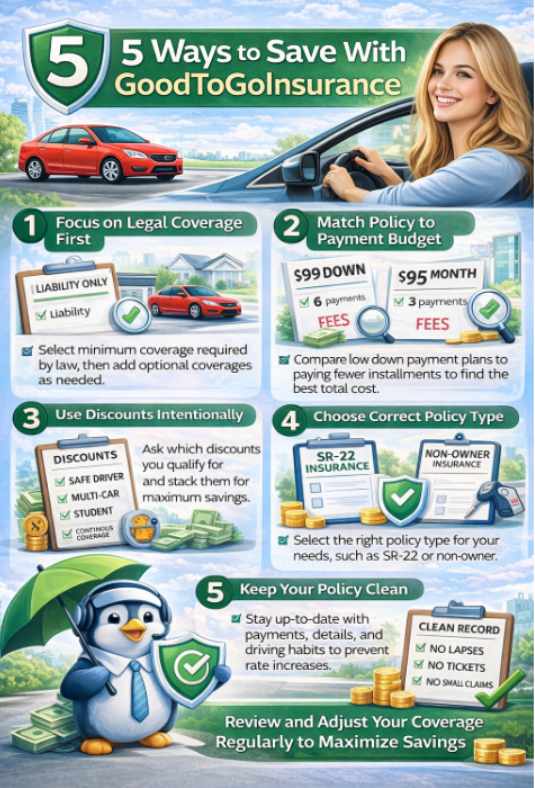
One of the most effective ways to save money with GoodToGoInsurance is to clearly separate what you must have from what you choose to have. Every state requires a minimum level of liability coverage, but anything beyond that is optional unless a lender is involved.
Drivers with older, paid-off vehicles often save the most by focusing on liability-only coverage that keeps them legal and protected against claims from others. Collision and comprehensive coverage protect your own vehicle, but they also add a high cost. If your car’s value is low, paying for those coverages may not make financial sense.
This is one reason GoodToGoInsurance is often used by drivers who need straightforward coverage without unnecessary extras. The key is being honest about your vehicle’s value and your ability to replace it if something happens. If replacing the car would not create a financial hardship, liability-focused coverage can dramatically reduce premiums.
That said, liability limits still matter. Choosing higher liability limits can protect your income, savings, and future earnings, and often adds less cost than people expect. Smart saving is about cutting the right things, not cutting protection blindly.
| Coverage Type | Best For | Cost Impact |
|---|---|---|
| Liability-Only | Older, paid-off, lower-value cars | Lowest cost |
| Full Coverage | Newer, financed, or higher-value vehicles | Higher cost |
| Higher Liability Limits | Drivers protecting income and assets | Often modest added cost |
Match Your Policy Structure to How You Actually Pay Bills
Insurance savings are not just about the premium itself. The way you pay for your policy can quietly increase or decrease the total amount you spend over the term. Many drivers focus only on the monthly payment and overlook fees, installment charges, and penalties tied to the payment structure.
Some policies offer low initial payments but spread the premium across more installments, increasing the total cost. Others reduce the overall price if you pay in fewer payments or in full. The best option depends on your cash flow, not just the sticker price.

A practical approach is to compare two versions of the same policy. One option uses a lower upfront payment with monthly installments. The other uses fewer payments or a higher upfront amount. When you compare the total cost over the full term, the difference is often larger than expected.
When drivers use GoodToGoInsurance, this comparison is especially important because the platform is often chosen for affordability and flexibility. Choosing the right payment structure can prevent unnecessary fees and reduce the risk of missed payments, which can lead to coverage lapses and higher future rates.
How Policy Costs Quietly Rise
Low upfront focus → More installments → More fees → Missed payment risk → Coverage lapse risk → Higher future premiums
Use Discounts Intentionally Instead of Assuming They Are Automatic
Discounts are one of the most misunderstood parts of auto insurance. Many drivers assume that if they qualify, the discount will be applied automatically. In reality, discounts often require verification, enrollment, or documentation.
Common discounts may include safe driving history, continuous insurance coverage, multi-vehicle policies, student status, and payment-related discounts. Some discounts remain in place as long as you qualify, while others expire and must be renewed.
The real savings come from stacking multiple discounts together. A single discount may not move the needle much, but three or four combined can significantly lower your premium.
When working with GoodToGoInsurance, drivers should confirm which discounts are available in their state and which ones are already included in the quote. Asking direct questions about eligibility and documentation helps ensure nothing is missed.
It is also important to update your information regularly. If your mileage drops, your commute changes, or your household situation improves, those changes can open the door to additional savings.
Discount Stacking Can Make a Bigger Difference
Combined savings are often stronger than any one discount alone.
Important: Discounts may require enrollment, verification, or documentation. Always ask which savings are already included in your quote and which ones require action.
Choose the Right Policy Type for Your Driving Situation
One of the most expensive mistakes drivers make is buying the wrong type of policy. Not every driver needs a standard owner policy, and choosing incorrectly can result in paying for coverage that doesn’t actually apply.
If you don’t own a vehicle but still need insurance for legal or license-related reasons, a non-owner policy is often far cheaper than a standard auto policy. It provides liability coverage when you drive vehicles you don’t own and helps maintain a continuous insurance history.
Similarly, drivers who need proof of insurance filings should make sure the policy they purchase includes the required documentation from the start. Delays or mistakes can lead to reinstatement fees, fines, or extended periods without coverage.
GoodToGoInsurance is frequently used in these situations because it can support specialized policy needs without forcing drivers into unnecessary coverage. The savings come from matching the policy to your real driving situation rather than defaulting to a one-size-fits-all option.
Standard Owner Policy
- For drivers who own a vehicle
- Can include liability and physical damage coverage
- Usually costs more
Non-Owner Policy
- For drivers who do not own a car
- Provides liability coverage only
- Often costs less
Avoid Hidden Costs By Keeping Your Policy Clean And Accurate
The final way drivers lose money is through avoidable risk signals. Insurance pricing is not based only on coverage choices. It also reflects how stable and predictable you appear as a customer.
Late payments, policy lapses, frequent small claims, and inaccurate information can all increase rates over time. Even something as simple as overstating annual mileage can lead to higher premiums.
Reviewing your policy details regularly helps prevent these problems. Make sure your address, mileage, vehicle use, and listed drivers are accurate. If something changes, update it promptly rather than waiting for renewal.
Drivers who use GoodToGoInsurance effectively tend to treat insurance as an active financial tool rather than a set-it-and-forget-it expense. That mindset helps prevent small mistakes from turning into long-term cost increases.
Late Payments
Payment problems can raise rates and create unnecessary risk.
Coverage Lapses
Even a short lapse can affect future pricing and eligibility.
Frequent Small Claims
Repeated claims can make you appear riskier to insure.
Inaccurate Information
Wrong mileage, driver details, or usage can quietly increase cost.
The biggest savings usually come from matching your coverage, payment plan, and policy type to your real situation.
The Final Word On Saving Money With GoodToGoInsurance
Saving money on car insurance isn’t about cutting corners. It’s about aligning your coverage, payment structure, and policy type with your real-world needs. The biggest savings usually come from choosing appropriate coverage levels, stacking discounts intentionally, avoiding lapses, and selecting the correct policy for your situation.
When used thoughtfully, GoodToGoInsurance can be part of a broader savings strategy for drivers who want affordable, straightforward coverage without unnecessary extras. The key is staying proactive, reviewing your policy regularly, and making adjustments as your life changes.
If you treat car insurance as something you manage instead of something that just happens to you, long-term savings become much easier to achieve. Compare affordable auto insurance quotes online in minutes and save hundreds on the quality coverage you deserve.
Editorial note: Coverage options, discounts, payment structures, and eligibility vary by insurer, state, driving history, vehicle type, and policy form. Always review full policy details before purchasing coverage.
Leave a Reply